That’s because the way people move through funnels looks nothing like the neat, linear models many teams still rely on.
B2B buyers now research independently, consult multiple stakeholders, and move fluidly between stages before they ever engage with sales. If your funnel still assumes a single lead, a single journey, and a single decision-maker, it’s time to update your model.
This guide explores what a modern B2B marketing funnel really is, how it has evolved, and why understanding it properly is critical to sustainable revenue growth.
The Sales and Marketing Funnel Defined
A B2B sales and marketing funnel is a framework that maps how potential customers become aware of your brand, evaluate your solution, and ultimately decide whether to buy.
At its core, it helps teams understand how potential buyers become customers, what they need at each step, and how marketing and sales can support them along the way.
Historically, this was split into two: marketing handled awareness and lead generation, while sales owned conversion and closing. But by 2026, that division no longer holds. The most successful companies operate as one revenue team, guiding prospects together through a shared funnel that reflects how decisions are actually made.
Why B2B Funnels Are Different
Unlike B2C purchases, B2B decisions are higher stakes. They typically involve larger financial commitments, longer buying cycles, and multiple decision-makers. That’s because in B2B, there’s more perceived risk, more internal alignment required, and often, more pressure to prove ROI.
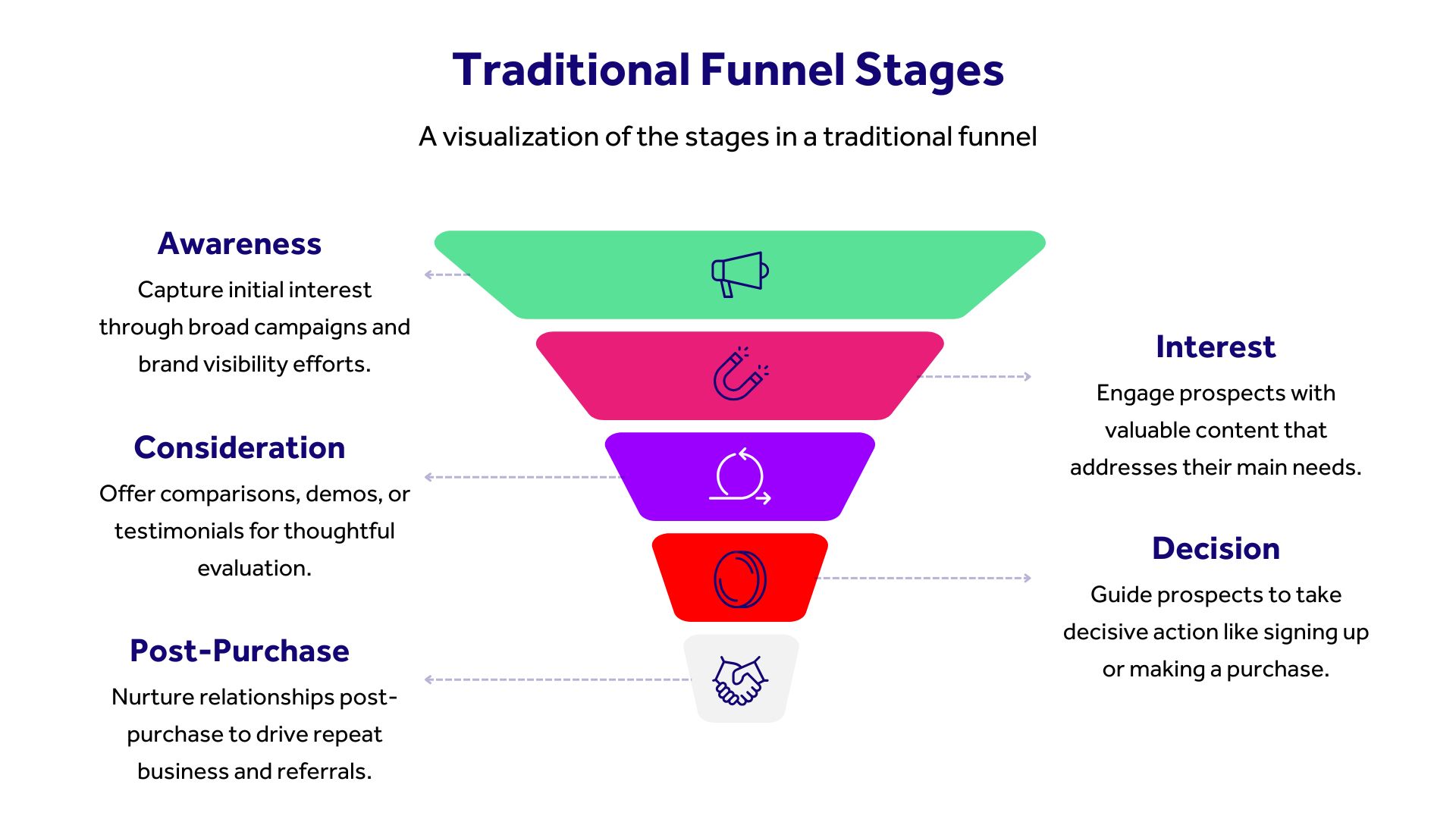
The Main Funnel Stages
The funnel stages are helpful to understand, as they represent distinct mindsets your buyers move through:
- Awareness: Buyers realise they have a problem or opportunity. They begin seeking out information, asking questions like “What’s causing this?” or “Should we act on it now?” The goal here is to be findable, credible, and helpful.
- Consideration: Buyers evaluate options. They compare different approaches, vendors, and even internal fixes. Trust matters here. So does education. Your job is to make the path clear and compelling.
- Decision: Buyers seek consensus. This is where stakeholder alignment, ROI evidence, and reassurance come into play. It’s less about pitching and more about enabling a confident yes.
- Post-Purchase: The funnel doesn’t end at closed-won. Retention, expansion, and advocacy are where long-term revenue is built. Marketing and sales must stay involved to deliver value and reinforce the relationship.
The Funnel Is No Longer Linear
A major shift in recent years is the move from linear to non-linear journeys.
Traditional sales and marketing funnels assume buyers enter at the top and progress steadily downward. But in reality, buyers bounce between stages, revisit earlier steps, and enter from multiple directions.
Furthermore, stakeholders might join the conversation at different times. One team may start with solution comparison while another is still exploring the problem. Your deals stall, restart, and accelerate in response to shifting priorities.
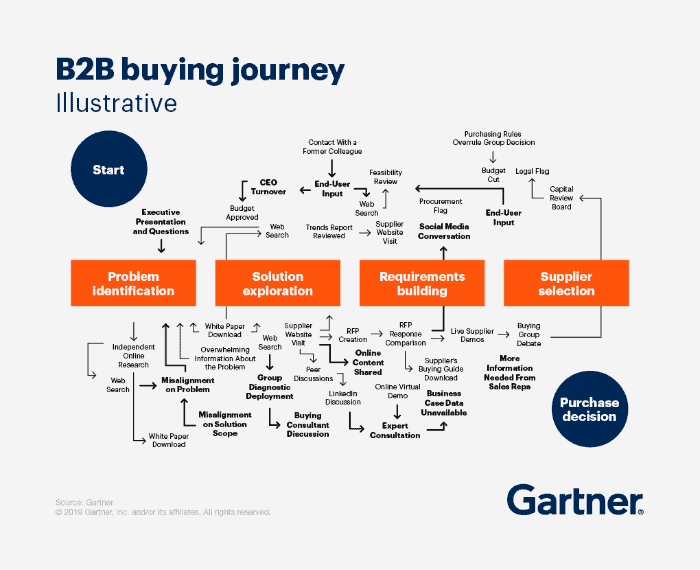
In 2026, smart teams recognise that funnels are no longer about nudging leads from point A to point B. They’re about identifying buying signals and responding at the right moment.
Why the Funnel Still Matters
Understanding the funnel helps teams align around a shared buyer journey. Without it, it’s easy to fall into old patterns, such as flooding the top of the funnel with low-quality leads, chasing cold accounts, or engaging too late.
A shared funnel model ensures everyone, from demand gen to SDRs to account execs, is working toward the same goals with a consistent understanding of what buyers need. It also helps identify where deals stall, where handoffs fail, and where messaging falls flat.
Most importantly, it focuses effort. Instead of guessing when to act, teams can track engagement, look for patterns, and prioritise what matters most: buying intent.
Funnels Are for Buying Groups, Not Individuals
One of the most important evolutions of the B2B funnel is this: it doesn’t serve leads; it serves buying groups.
Rarely does a single person make the decision. Instead, there are champions, blockers, users, budget holders, and executive sponsors. Each has a different goal, timeline, and view of your value, and modern funnels must reflect this.
That means tracking group behaviour, recognising when multiple stakeholders from the same company are engaged, and tailoring content to different perspectives.
From Stage-Based to Signal-Led
In the past, funnel progress was determined by actions, such as downloading a guide, attending a webinar, or booking a call. But those signals are incomplete.
In a signal-led funnel, what matters is engagement patterns. Are multiple team members visiting your site? Is there a spike in content interaction? Are they returning to high-value pages, such as pricing or integrations?
These behaviours often indicate buying momentum, even before a form fill. That’s why modern funnels are designed to surface and act on these signals: it allows teams to engage when interest is peaking, not after it’s cooled.
Improve Your Funnel Visibility
If you’re relying on form submissions to know who’s in your funnel, you’re missing out on the majority of active research.
But with website visitor identification tools like Lead Forensics, you can fill the gap by identifying the companies visiting your site, even if they remain anonymous. It tracks your business website visitors to reveal which pages they viewed, how often they returned, and what they’re most interested in. That gives your team valuable first-party intent data, so you can reach out with context and confidence.
In a world where buyers hide their intent until the last minute, this early insight is a competitive advantage. It helps you act faster, personalise better, and build momentum before your competitors even realise there’s an opportunity.
Not already using Lead Forensics? Book a demo to learn more.