Only 30% of B2B sales reps hit quota in 2024, and for much of the other 70%, the problem wasn’t effort, it was visibility.
Most sales teams track activity metrics, like calls made, emails sent and meetings booked, without a clear line of sight to whether those activities are translating into revenue at the required rate.
But sales velocity changes that. It connects the inputs of your pipeline, such as the number and quality of opportunities, the size of deals, how often they close, and how fast, into a single number that reflects daily revenue generation.
Crucially, sales velocity is also a forward-looking metric: a decline in sales velocity today signals a revenue problem next quarter, before it’s too late to act.
This guide explains the formula, how to benchmark your result, and the specific actions that move each lever.
What Is Sales Velocity?
Sales velocity measures the rate at which your business generates revenue from its pipeline and is expressed as a dollar value per day. It combines four variables: the number of qualified opportunities in your funnel, the average size of your deals, your win rate, and the average length of your sales cycle. Together, these four inputs give B2B sales leaders a single, composite view of pipeline health.
Unlike conversion rate, which tells you how effectively you close, or pipeline coverage, which tells you how much volume you have, sales velocity tells you how efficiently your entire sales operation is turning effort into revenue over time.
This makes it a particularly valuable metric for forecasting. For example, a sales team can have strong activity numbers and a full pipeline but still miss its target if deals are smaller than expected, taking longer to close, or leaking at the conversion stage. Sales velocity surfaces those dynamics in a way that individual metrics don’t.
The Four Variables in the Sales Velocity Formula
Before calculating your sales velocity, you need a reliable number for each of the following:
Number of opportunities
How many qualified opportunities are currently active in your pipeline? The emphasis here is on qualified. Inflating this number with poorly-fit contacts that are unlikely to progress distorts your sales velocity and produces unreliable forecasts. These should be leads that genuinely match your ideal customer profile (ICP) and have shown clear buying intent.
Average deal size
The average dollar value of a closed deal. For subscription-based products, it’s worth calculating this against annual contract value (ACV) or customer lifetime value (CLV) rather than monthly recurring revenue, as this gives a more accurate picture of the commercial impact of each won opportunity.
Win rate (conversion rate)
The percentage of opportunities that convert to closed deals. The average B2B win rate is approximately 21%, though this varies considerably by industry, deal complexity, and pipeline quality. Win rate is heavily influenced by how well opportunities are qualified at the top of the funnel, and a low win rate is often a lead quality problem rather than a sales execution problem.
Pipeline length (sales cycle)
The average number of days from first contact to closed deal. B2B sales cycles vary widely by segment: SMB deals typically close in 14 to 30 days, mid-market deals in 30 to 90 days, and enterprise deals in 90 to 180 days or more. Pipeline length is the only variable in the sales velocity equation that you want to reduce.
How to Calculate Sales Velocity
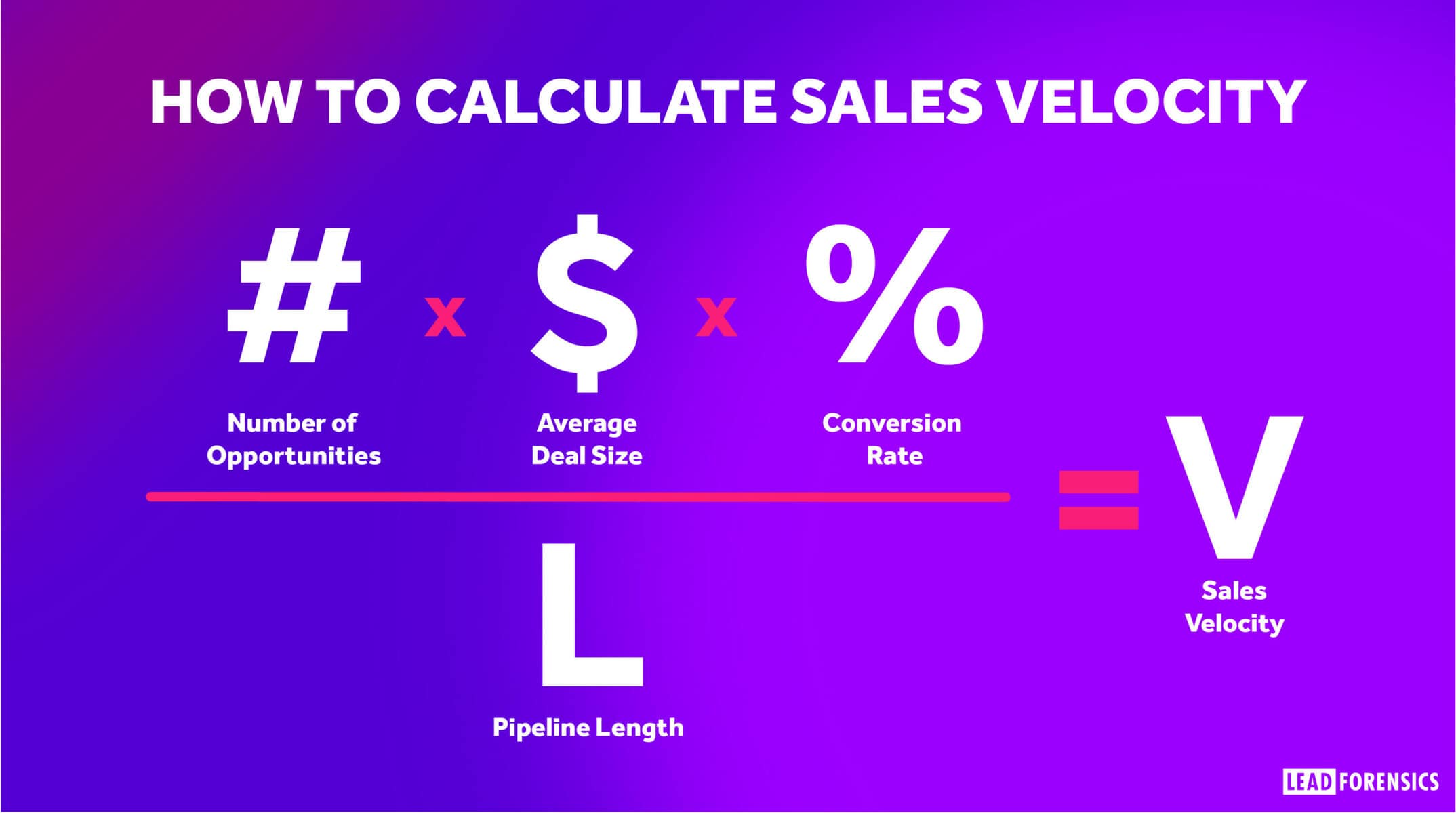
The formula is:
Sales velocity =
number of opportunities × average deal size × win rate ÷ pipeline length (days)
The result is your estimated daily revenue generation. Here’s a worked example:
500 (opportunities) × $2,000 (average deal size) × 0.25 (win rate) ÷ 30 (days)
= $8,333 per day
Improving any one of the four variables will increase your sales velocity. To illustrate the impact of each lever in isolation:
- Double opportunities: 1,000 × $2,000 × 0.25 ÷ 30 = $16,667 per day
- Increase average deal size: 500 × $3,000 × 0.25 ÷ 30 = $12,500 per day
- Improve win rate: 500 × $2,000 × 0.30 ÷ 30 = $10,000 per day
- Shorten sales cycle: 500 × $2,000 × 0.25 ÷ 27 = $9,259 per day
One important discipline: only change one variable at a time when running improvement experiments. Adjusting multiple levers simultaneously makes it impossible to identify which change produced the result.
How to Improve Your Sales Velocity
Knowing your sales velocity number is only useful if you act on what it reveals. Here’s how to approach improvement across each of the four variables.
Increasing the number of opportunities
The most direct route to more opportunities is improving the quality and volume of your lead generation, but quality must come first. A pipeline full of poorly-qualified contacts that won’t progress drags down both win rate and sales cycle length and can suppress sales velocity even as raw opportunity numbers grow. Focus lead generation activity on accounts that closely match your ICP.
One consistently overlooked source of high-intent opportunities is your own website. Around 98% of B2B website visitors don’t submit a form, they browse, evaluate, and leave without identifying themselves. Website visitor identification software like Lead Forensics identifies those companies, providing contact details for key decision-makers alongside behavioral data showing which pages they viewed and how many times they’ve visited.
It’s a good way to boost sales velocity: when sales reps have access to buyer intent data, 65% say they have a better chance of closing deals.
Increasing average deal size
Average deal size typically increases through two routes: more disciplined ICP targeting and deliberate upsell and cross-sell motion. On targeting, if your highest-value deals consistently come from a specific segment, like a particular industry, company size band, or use case, that’s a signal to shift prospecting weight toward that segment rather than maintaining broad coverage across all tiers.
On upsell and cross-sell, deals can be expanded at the point of sale through tiered packages, multi-year commitments, or bundled services, provided the value of each addition is clearly established before the negotiation stage.
One further consideration: if your average deal size is being pulled down by a large volume of small deals, it’s worth assessing whether those deals are consuming disproportionate sales resource relative to their revenue contribution. This isn’t always the case, for example high-volume, low-ACV business can be highly efficient if the sales motion is appropriately streamlined, but it warrants scrutiny.
Improving your win rate
A low win rate is most commonly a pipeline quality problem rather than a sales execution problem. If the wrong accounts are entering the funnel, no amount of sales technique improvement will close the gap. The first step is auditing your qualification criteria: are the opportunities currently in your pipeline genuinely likely to close, or are reps holding on to long-shot deals that inflate pipeline coverage without contributing to revenue?
Where qualification is solid, win rate improvement comes from better discovery, stronger objection handling, and tighter alignment between sales messaging and the prospect’s actual business problem. Analysis of lost deals by stage is a reliable starting point; where deals consistently drop off indicates where process or messaging needs adjustment.
Win rate also benefits from faster follow-up: responding to high-intent signals quickly, whether that’s a demo request, a return website visit, or a specific content engagement, prevents competitors from gaining ground during the decision process.
Shortening your pipeline length
Sales cycle compression is one of the harder improvements to drive, particularly as B2B buying groups have grown in size and complexity. Now, the average deal now involves 6.8 stakeholders, and CFO involvement in purchase decisions has increased significantly.
That said, there are proven levers that can shorten your sales cycle. Multi-threading, where you build relationships across multiple members of the buying committee rather than relying on a single champion, removes the risk of deals stalling when a contact leaves or loses internal influence. Mutual action plans, agreed with the prospect at an early stage, establish shared accountability for key milestones and reduce the likelihood of deals drifting without progress.
Bonus: Get a Boost with Website Visitor Identification
Most efforts to improve sales velocity focus on what happens inside the pipeline, but website visitor identification addresses what happens before it.
Around 98% of B2B companies visiting your website never submit a form. Instead, they research, compare, and leave without identifying themselves. That’s a significant volume of commercial intent that never reaches your sales team.
Lead Forensics changes that by identifying those companies and surfacing contact details for key decision-makers, along with behavioral data showing exactly what they were interested in. This means your reps can reach out to warm, in-market accounts at the moment their intent is highest, and before a competitor does.
As a result, more qualified opportunities enter the pipeline, with better context for every conversation, leading to faster progression and stronger conversion rates. It’s one of the most direct ways to improve your sales velocity without increasing headcount or ad spend.
Sales Velocity FAQS
What is a good sales velocity benchmark?
There is no universal benchmark for sales velocity, because the number is specific to your business model, deal size, and market. What matters is the direction of travel: a consistently increasing sales velocity indicates that your pipeline is becoming more efficient over time, while a declining number warrants investigation across all four variables. The most useful approach is to establish your own baseline, track it consistently, and set improvement targets against it rather than comparing the raw figure to external benchmarks.
How often should I calculate sales velocity?
Sales velocity should be calculated at least monthly, with quarterly reviews used to identify longer-term trends. Monthly tracking allows you to spot early signals of pipeline deterioration before they become revenue problems. For teams with shorter sales cycles, weekly calculation can be valuable, particularly when running improvement experiments on individual variables, where you need a fast feedback loop to understand whether a change is having the intended effect.
Which of the four variables should I prioritize improving first?
Start with the variable that has the biggest gap relative to its potential. For most B2B teams, that’s either opportunity quality or win rate, because both are frequently undermined by poor lead qualification at the top of the funnel. Improving the quality of what enters your pipeline creates a compounding effect: better-fit opportunities close faster, at a higher rate, which improves three of the four variables at once. Average deal size is often the best lever for more mature teams that have qualification under control and want to grow revenue without proportionally increasing headcount.
Can sales velocity be used for individual rep performance tracking?
Yes, sales velocity can be calculated at the individual rep level and is a more commercially meaningful performance indicator than activity-based metrics like call volume or email send rate. Comparing sales velocity across reps can identify high performers whose pipeline behavior, particularly around qualification, deal size, and follow-up speed, can be replicated as best practice. It also helps identify where individual reps need support: a rep with strong opportunity volume but poor win rate has a different development need than one with high win rate but a long sales cycle.