Skip to content

How Lead Forensics identifies up to 80% of B2B visits
Lead Forensics is the original website visitor identification tool. As the market leader, it beats competitors in side-by-side comparisons almost every time (in 96% of demos).
Like all data-based tools, website visitor identification is only useful when the information behind it is accurate, validated, and commercially relevant. A high volume of matches may look impressive, but if those matches are weak, outdated, or poorly verified, they create more noise than clarity.
Lead Forensics takes a different approach. Our platform is built around data quality, not match rate alone. We focus on identifying the businesses behind website visits with a high level of confidence; to give your B2B sales and marketing teams the information they need to act on that interest.
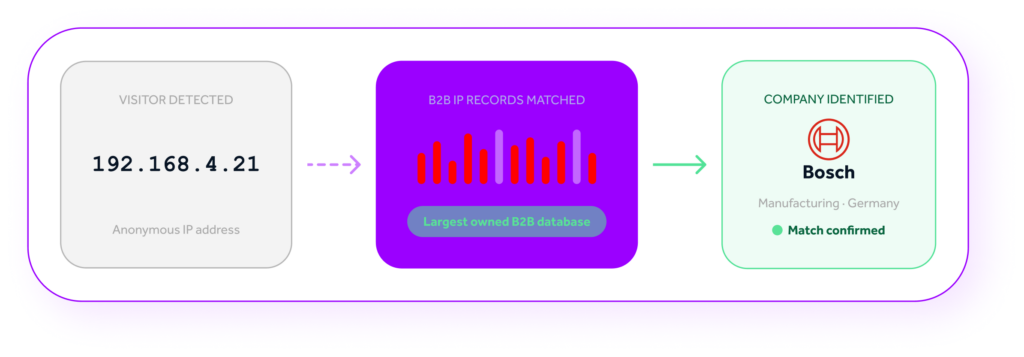
Built for accurate business identification
Lead Forensics uses a small piece of tracking code to identify business website visitors. Once added to your website, the code captures visit activity and supports the identification of companies engaging with your site.
When a business visits your website, Lead Forensics assesses the visit using a combination of technologies, including globally compliant tracking, reverse IP lookup, private databases, analytics and machine learning. These technologies work together to interpret website activity, identify the business associated with a visit where possible, and provide relevant company and behavioral information to your team.
At a practical level, this means Lead Forensics can identify which companies have visited your website, which pages they viewed, how long they spent on the site, how they arrived, and whether they returned. It can also provide firmographic information such as company name, industry, size and location, alongside relevant business contact data where available.
This gives your team a clearer view of business interest, account engagement, and potential buying intent.
Why data quality matters more than raw match rate
Match rate is an important measure, but it should never be treated as the only measure of value.
That’s because website visitor identification depends on a range of factors, including industry, geography, audience profile, company size, traffic source, and network type. A website attracting large enterprise visitors from established corporate networks may produce a different identification rate from a website attracting smaller businesses, remote workers, mobile users or mixed B2B and B2C traffic.
For that reason, the most important question is not “how many visitors can be matched?” but actually “how many of those matches are accurate enough to support a business decision?”
It is possible to increase visible match rates by accepting lower-confidence data. For example, a platform can broaden its data pool, relax its quality thresholds, or may surface weaker matches to create the impression of higher coverage.
But this does not necessarily help sales and marketing teams.
If the data is inaccurate, teams waste time on the wrong accounts, misread campaign performance, contact irrelevant businesses, or make decisions based on unreliable signals.
That’s why Lead Forensics prioritizes validated business identification. Our focus is on surfacing information that is accurate, relevant and useful enough for teams to act on.
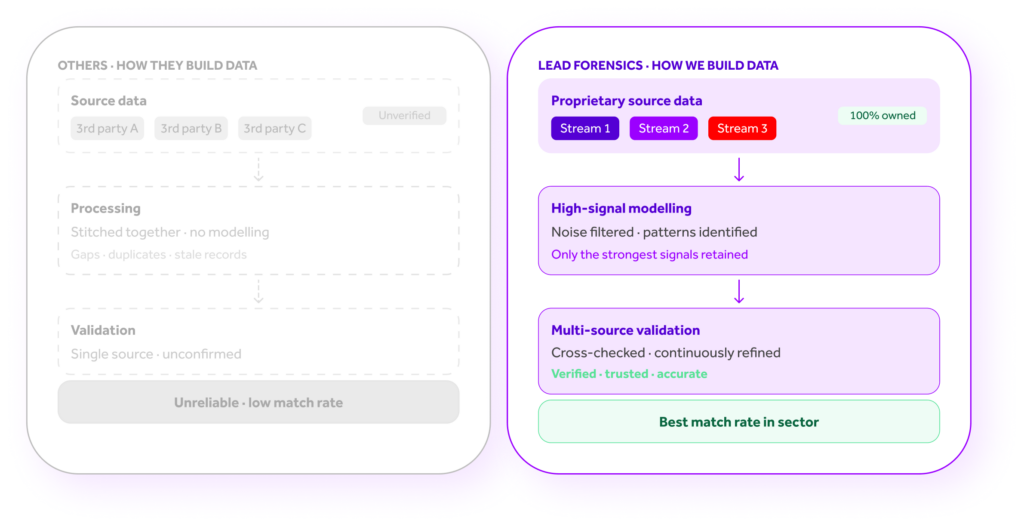
The Lead Forensics data advantage
Lead Forensics has spent years building specialist expertise in B2B website visitor identification. At the center of this approach is an owned database of identified B2B IP addresses, built, maintained and refined in-house.
This matters because data ownership gives us greater control over quality, consistency, and validation. Lead Forensics is not simply a pass-through layer that accepts and displays whatever an external data source provides. Our core identification process is owned, managed, and quality controlled by Lead Forensics.
Where supporting data sources are used, they are not treated as complete answers in isolation. Data is assessed, checked, and validated before it is surfaced to customers. This helps ensure that the information shown in the platform is not only available, but reliable.
The result is a more controlled data environment. Identification is based on the strongest available signals and supported by proprietary validation processes designed to improve confidence in the final result.

Why we do not rely on waterfall data models
Many data providers use what is known as a waterfall model. In a waterfall approach, sources are ranked in a fixed order. The system checks the first source, then moves to the next source if no result is found.
This can be useful for increasing coverage, but it does not necessarily produce the most reliable outcome.
The issue is not that waterfall data is always wrong. The issue is that it can prioritize availability over validation. If the first available source returns a result, that result may be accepted before the wider evidence has been properly assessed.
For example, one source may associate a business IP address with a particular company, while another source may suggest a different company, parent organization, location, or network owner. A basic waterfall process may accept the first successful result, even where other available signals disagree.
That can increase the number of visible matches, but it can also increase the risk of inaccurate identification.
Lead Forensics takes a different approach. Rather than relying on a single preferred source or accepting data in a fixed sequence, we assess information across multiple sources and validation layers using our in-house AI and machine learning technologies. Where signals align, confidence increases. Where signals conflict, the data requires further assessment before it can be treated as reliable.
This validation-led approach helps reduce the risk of poor-quality matches being passed to customers. It also helps protect the usefulness of the platform for sales and marketing teams who need data they can trust.

In-house validation before customer delivery
Lead Forensics validates data before it is presented in the platform.
This is a key part of our methodology. We are not only looking for a match. We are looking for a match that is strong enough to support real commercial action.
That distinction matters. Sales and marketing teams use website visitor identification to prioritize accounts, assign follow-up, measure campaigns, understand buyer intent and uncover opportunities that would otherwise remain hidden. If the underlying data is weak, every action that follows becomes less reliable.
In-house validation helps ensure customer-facing data is not simply the first available answer from a data source. Instead, information is assessed against multiple signals and quality checks before it is surfaced.
This is why Lead Forensics puts data quality at the center of its approach. The goal is not to fill a dashboard with the largest possible number of records. The goal is to provide accurate, validated business intelligence that helps teams make better decisions.

Company-level identification, not speculative person-level tracking
Lead Forensics is focused on company-level website visitor identification.
Our platform identifies the businesses visiting your website and provides the commercial context needed to understand their engagement. It does not rely on unsupported claims that every anonymous website visit can be confidently tied to a specific named individual.
This distinction is important.
Some tools in the market promote person-level visitor identification. These approaches may use signals such as cookies, device identifiers, fingerprinting, public professional profiles or third-party partner networks to try to associate anonymous visits with individual people.
While these methods can produce more granular outputs, they also introduce greater complexity around accuracy, consent, privacy expectations, and data governance. They can also create a misleading impression of certainty.
Lead Forensics takes a more reliable and business-focused position. We identify companies showing intent and provide relevant business intelligence and contact data to support appropriate follow-up. This gives sales and marketing teams the account-level insight they need, without relying on speculative person-level claims.
For B2B teams, this is often the more practical view. Most buying decisions are made by organizations with a wider decision-making unit, not isolated individuals. Understanding which companies are engaging, what they are looking at, and how their interest develops over time gives teams a strong foundation for relevant, timely and responsible outreach.

How we put you in control of your data
Data responsibility sits at the center of how Lead Forensics operates, not just how it identifies businesses.
We process data in trusted jurisdictions and protect it using approved legal safeguards wherever international transfers are required. When you integrate Lead Forensics with your CRM or marketing platforms, that access is used only to deliver the services and functionality you’ve selected, and nothing more.
You remain the Data Controller for the personal data you provide. Lead Forensics acts as your Data Processor, operating under your instructions and in accordance with the applicable Data Processing Agreement. We process only the information needed to provide relevant company, website-visitor and intent intelligence, and we do not use access to your systems for any purpose beyond what’s necessary.
Connections to your CRM, website and marketing platforms are enabled by you, managed under your direction, and limited to the agreed purpose. Just as our core B2B identification database is built and maintained in-house, giving us direct oversight of data quality, accuracy and governance, our approach to your data focuses primarily on identifying businesses and understanding company-level website activity, with personal data used only where required for the contracted services.
We aim to make our data practices transparent, supported by contractual documentation and compliance resources. Our information security controls are governed through a recognised security framework and backed by independent certification.
Reliable data creates better decisions
The purpose of Lead Forensics is not simply to reveal more website visitors; it is to reveal the right businesses, with the right context, at the right level of confidence.
That is why our methodology is built around data ownership, in-house validation, and quality-led identification. We combine proven tracking technologies, reverse IP lookup, private databases, analytics, machine learning and proprietary validation processes to turn website activity into reliable B2B insight.
For sales and marketing teams, this means less guesswork and more confidence. Instead of relying only on anonymous analytics or form fills, teams can see which businesses are already engaging, understand what they care about and respond with greater relevance.
Accurate data does not just improve reporting. It improves action.
Lead Forensics helps businesses turn anonymous website traffic into validated company-level intelligence, so teams can focus on the opportunities most likely to matter. Book a demo now to learn more about how we can help your business find more leads.







+60k
Stop missing out on opportunities