Skip to content

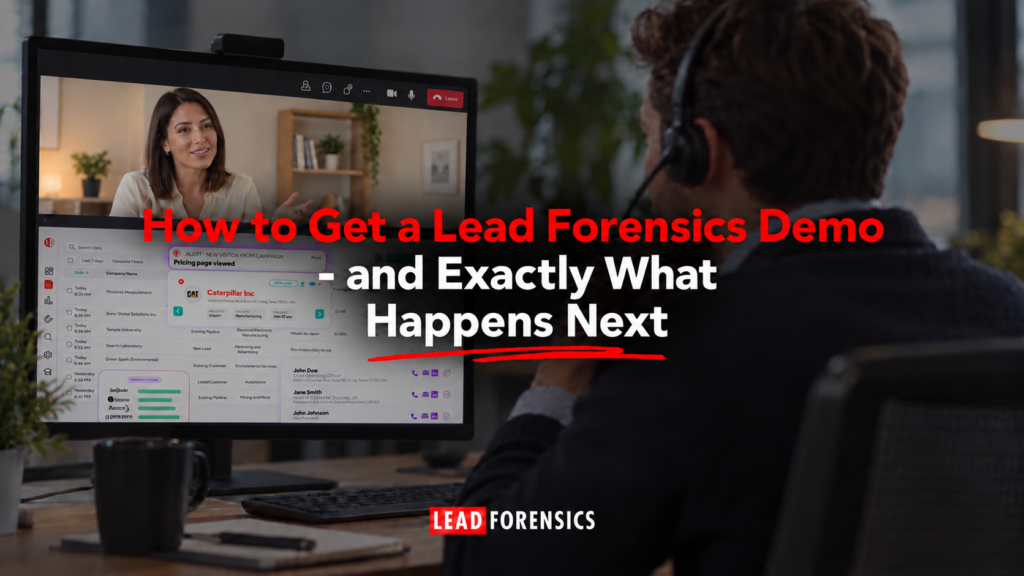
We often get asked why Lead Forensics asks you to book a demo before your free trial, and why our pricing isn’t on our website. It’s a fair question. The short answer is that the demo is how we make sure your trial works. You’re set up for success from day one, and you find out quickly whether website visitor identification can genuinely work for your business. Pricing comes at the end of the trial, alongside an ROI calculation based on your own website’s data.
When you book a Lead Forensics demo, we’ll schedule a call with a member of our team who knows and understands your sector. From there, we set up a two-week free trial on your website, configured around what you want to learn, and finish with a full results presentation and ROI calculation. You’re never left to work it out alone.
Here’s the whole process from “book a demo” to “go live”, step by step, with no surprises.
Why we start with a demo (and why it isn’t a sales hoop)
If you’ve read that Lead Forensics makes you sit through a demo, or hides its pricing, here’s what the demo actually does for you.
It gets you a free trial that’s built to work. Plenty of tools let you install a tag and start a trial on your own. But visitor identification only pays off if you know which visits matter and what to do about them. Left alone, most teams spend their trial learning the dashboard, not finding opportunities.
The demo is where we learn what you want to achieve, so your trial shows you that from day one. It’s also where you find out, honestly, whether website visitor identification can work for your business. If your traffic is too low or your sales motion isn’t a fit, we’d rather tell you then than let you waste two weeks.
On pricing: what you pay should reflect the value you’ll get, and we can’t judge that until we’ve seen your traffic. So at the end of your trial, you see pricing alongside an ROI calculation built on your own website’s data. You’re weighing the cost against real results, not guesswork.
Step 1: Your demo, with someone who knows your sector
Your demo is run by someone with experience in your industry. Someone selling industrial machinery has different goals from someone selling software, so we match you with a person who already understands how buyers in your market behave.
In the demo, we’ll talk through what you want from website visitor identification and which of our seven use cases matter most to you. Those use cases are:
- Identifying sales leads you never knew you had
- Spotting buying intent before your competitors do
- Getting better visibility of your pipeline
- Re-engaging lapsed pipeline opportunities
- Fuelling ABM campaigns with real engagement insight
- Spotting live upsell and cross-sell opportunities
- Winning back lapsed customers
We’ll also ask what you most want to see. That might be which ICP prospects are reaching your site, how they’re getting there and what’s driving them, which pages they’re viewing, or whether target accounts and existing customers are visiting. Everything you tell us shapes how your trial is set up.
Step 2: We set up your trial around your goals
After the demo, we give you the Lead Forensics tracking code to add to your website. Once it’s live, we start identifying the companies visiting your site.
At the same time, we configure your trial portal around the use cases you said matter most. As data comes in, it’s displayed and segmented to answer your questions, not buried in a generic dashboard. If your priority is ICP prospects, that’s what you’ll see first. If it’s target accounts or existing customers, they’ll be flagged.
Step 3: Your two-week trial, with regular updates
Your free trial runs for two weeks. During that time, your Lead Forensics contact will keep you updated on what they’re seeing.
Because they already know what you’re looking for, and what tends to deliver value in your sector, those updates focus on the visits that matter to you. You don’t need to log in every day to spot the opportunities.
Step 4: A detailed results presentation and ROI calculation
At the end of the two weeks, you get a full presentation of your trial data. Your Lead Forensics contact will have dug into it and done their own analysis, based on the goals you set out in the demo.
That presentation includes your pricing and a detailed ROI calculation built on what was actually seen on your website, not hypothetical benchmarks. You’ll also get access to all the trial data, so you can review it internally and share it with your team. That way, everyone involved in the decision is working from the same evidence.
Step 5: Take time to decide, then go live within hours
You’ll have time to review the results with your team before making a decision. There’s no pressure to sign on the spot.
If you decide to go ahead, we simply extend your existing tracking code. Because your account is already configured, you’re up and running within hours of saying yes, with no rebuild.
Step 6: A proper handover into onboarding
Onboarding picks up where the trial left off. You’ll have a detailed handover meeting with your Lead Forensics contact and your Customer Success Manager, where they share everything learned so far. You won’t have to repeat yourself.
Your Customer Success Manager then builds on that, guides you through the next stage and takes the key setup work off your plate. Your job is to act on the results.
Guided trial vs DIY free trial: why it matters
A guided trial gets you to value faster. With a self-serve trial, you install a tag, open a dashboard and try to work out what you’re looking at. Many teams never get past that point before the trial ends.
With Lead Forensics, the thinking is done before the code goes live. Your trial is already set up around the use cases that matter to your business and sector, so you see relevant results from day one. And because the configuration carries over, there’s no restart when you sign.
| Self-serve free trial | Lead Forensics guided trial | |
|---|---|---|
| Setup | You configure it yourself | Configured for you, around your goals |
| Who you speak to | Often no one | A specialist in your sector |
| During the trial | You check the dashboard | Regular updates on relevant visits |
| At the end | You draw your own conclusions | Full analysis and ROI calculation |
| Going live | Often a fresh setup | Live within hours of saying yes |
Frequently asked questions
How do I get a Lead Forensics demo? Book a demo through the Lead Forensics website. You’ll be matched with someone who has experience in your sector, who will talk through your goals and set up a free trial on your site.
Does Lead Forensics offer a free trial? Yes. Lead Forensics offers a two-week free trial, set up after your demo and configured around the use cases that matter most to your business.
Why do I need a demo before the free trial? The demo lets us understand what you want to achieve, so your trial is set up to show the most relevant data from day one. It shortens time to value compared with a self-serve trial.
Do I have to have a demo to try Lead Forensics? Yes, and it’s there to help you, not slow you down. The demo means your free trial is set up around your goals from day one, so you see relevant results rather than spending two weeks working out a dashboard.
Why isn’t Lead Forensics pricing on the website? Because pricing should reflect the value you’ll get, and that depends on your traffic and goals. You see your pricing at the end of your free trial, alongside an ROI calculation based on the companies that actually visited your site.
How long is the Lead Forensics free trial? Two weeks. During that time you’ll get regular updates on the companies visiting your site.
What happens at the end of the trial? You’ll get a detailed presentation of your trial data, an ROI calculation based on real visits to your website, and access to all the data to share with your team.
How quickly can I go live after the trial? Within hours of saying yes. We extend your existing tracking code, so there’s no new setup.
What happens after I sign up? You’ll have a handover meeting with your Lead Forensics contact and your Customer Success Manager, who will guide you through onboarding and take care of the key setup work.
Ready to see who’s on your website?
Your best buyers are probably already on your site. You just can’t see them yet. Book a demo, tell us what matters to you, and we’ll show you exactly which companies are researching your business.