Skip to content

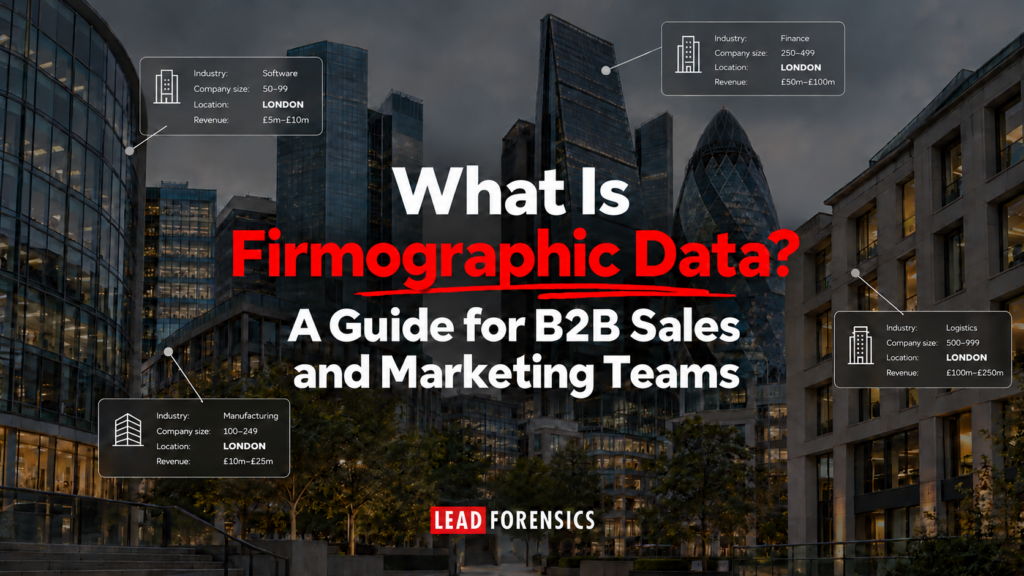
Firmographic data gets referenced constantly in B2B marketing and sales, usually without much explanation. It shows up in conversations about ideal customer profiles, lead scoring, and account-based marketing, almost always treated as something everyone already understands. Here’s what it actually is, the attributes it covers, and how B2B teams put it to use.
What Is Firmographic Data?
Firmographic data is company-level information that describes a business rather than an individual. It covers things like industry, size, revenue, location, and structure. Think of it as the B2B equivalent of demographic data. Demographics tell you who a person is. Firmographics tell you what kind of organisation you’re dealing with.
That distinction matters because B2B buying decisions are rarely made by one person acting alone. A 40-person logistics firm and a 4,000-person enterprise might both have an “Operations Manager.” Those two companies need completely different products. They need different pricing and sales approaches too. Firmographic data is how you tell them apart before a conversation ever starts.
The Core Firmographic Attributes
Most firmographic profiles draw on a consistent set of attributes, even if the exact mix varies by provider:
- Industry classification – the sector a company operates in, often standardised against a taxonomy like NAICS or SIC codes
- Company size – usually measured by employee count, and commonly banded into groups such as micro, small, medium, and large
- Revenue range – annual turnover, which signals both budget and buying power
- Location – headquarters and any additional offices or operating regions
- Business structure – whether the company is public, private, a subsidiary, or a franchise
- Years in operation – a rough proxy for maturity and stability
- Growth signals – recent funding rounds, headcount changes, or new office openings
None of these attributes mean much in isolation. A small company isn’t automatically a weak lead. A well-funded one isn’t automatically a good fit either. The value comes from combining several attributes into one profile, then checking it against the customers who already buy from you. For more on building that reference profile, see our guide to defining and using an ideal customer profile.
Why Firmographic Data Matters for B2B Teams
Building and Refining Your ICP
Your ideal customer profile is only as sharp as the data behind it. Firmographic attributes give you something concrete to check new prospects against. Instead of a gut feeling about who “feels like” a good fit, you can filter directly on industry, headcount, and revenue band.
Scoring and Prioritising Leads
Firmographic fit is usually one half of a good lead scoring model. The other half is behavioural signals, like page visits or content downloads. A lead from a company that matches your ICP on size and industry deserves more attention than one that doesn’t – even before anyone looks at what they’ve actually done on your site. Our guide to lead scoring for B2B sales covers how to combine the two, and our guide to B2B sales covers where qualification fits into the wider sales process.
Powering Account-Based Marketing
ABM depends on knowing exactly which accounts you’re targeting before you spend a penny on outreach. Firmographic data is how most ABM programmes build that target list in the first place. Grouping accounts by industry and size lets campaigns speak to a specific segment, rather than a generic audience.
Personalising Outreach and Pricing
A message built for a 20-person startup rarely lands with a 2,000-person enterprise, and vice versa. Firmographic data lets sales and marketing tailor case studies and messaging to the size and type of company they’re speaking to. Pricing tiers can shift the same way, instead of one generic pitch for everyone. Our guide to B2B marketing covers where ABM and segmented messaging fit alongside your other channels.
Sizing Markets and Tracking Competitors
Firmographic attributes aren’t only useful for scoring inbound leads. Grouping companies by industry, size, and location is also how teams estimate how big a given market actually is, spot fast-growing companies worth approaching early, and keep tabs on where competitors are winning deals.
Firmographic Data and Website Visitor Identification
One specific application is worth calling out on its own: standard web analytics show page views and session counts, but not which companies they came from. Sales intelligence tools close that gap by matching anonymous visitor traffic back to real companies, surfacing the firmographic profile behind traffic that would otherwise stay invisible. For a closer look at how that matching actually works, see our technical guide to B2B website visitor identification.
How to Start Using Firmographic Data
- Pull firmographic data on your existing best customers first, and look for the patterns – industry, size, and revenue bands that show up again and again
- Turn those patterns into explicit ICP criteria, rather than leaving them as an unwritten sense of “who we usually sell to”
- Add firmographic fit as a weighted factor in your lead scoring model, alongside behavioural and engagement signals
- Decide how you’ll keep that data current – a third-party provider, a CRM enrichment integration, or building your own matching, depending on volume and budget
Firmographic Data FAQs
What’s the difference between firmographic and demographic data?
Demographic data describes individual people – age, job title, seniority. Firmographic data describes the organisation that person works for – its industry, size, and revenue. B2B teams typically need both. Demographic data tells you who you’re talking to. Firmographic data tells you about the company they represent.
How is firmographic data collected?
It comes from a mix of sources. Public business registries, company websites, and press releases are common starting points. Third-party data providers maintain their own company databases, which is usually the fastest way to get consistent coverage across thousands of prospects at once.
How accurate is firmographic data?
Accuracy varies by provider and by attribute. Industry and location tend to be reliable. Revenue estimates for private companies are often modelled rather than reported directly, so treat them as a strong directional signal rather than an exact figure. Prioritise providers that refresh their records regularly.
Can firmographic data replace behavioural data?
No. Firmographic data tells you whether a company fits your target market. It doesn’t tell you whether they’re actually interested right now. The strongest lead scoring models combine firmographic fit with behavioural signals, such as which pages a company’s visitors are viewing and how often.