Skip to content

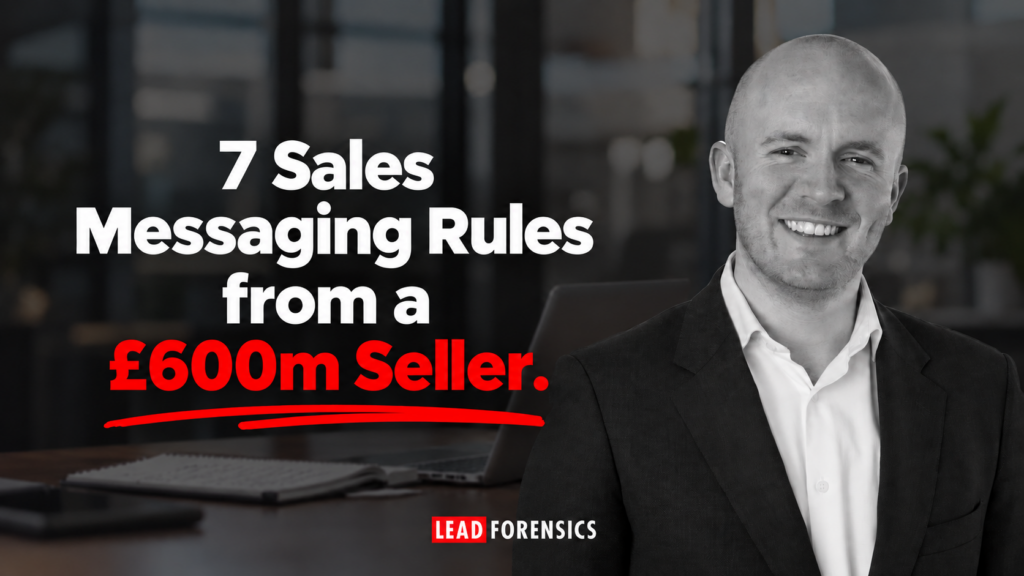
James Newell has spent nine years fixing that problem. Before founding Clear Sales Message, he spent twelve years in B2B sales for a car manufacturer and sold £600 million worth of vehicles. “I’m a man who sells cars,” as he puts it, “but not a car salesman.” He also hosts The Daily Sales Message, which has now passed 1,000 episodes.
In our podcast episode with James Newell, he shared the principles he uses to make complicated offers easy to understand. Here are seven of them.
1. Fix the 6 vs 9 problem
Picture a number painted on the floor between two people. One sees a 6. The other sees a 9. Both are right from where they’re standing, and neither is going to change their view.
James says that’s what happens in most sales conversations:
“As salespeople, we talk about features because that’s what matters to us. Clients want to talk about benefits, and never the twain shall meet.”
He links this to the false consensus effect, our tendency to assume other people see things the way we do. Sellers spend all day close to their product, so the specs feel self-explanatory. To the buyer, they’re just noise. Research on why abstract language loses people points the same way: the more you know about something, the harder it is to remember what it’s like not to know it.
James’s fix is a four-word bridge. When you catch yourself listing features and the conversation is going nowhere, say “what that means is…” and finish the sentence with the outcome for the buyer. It works whether you’re on a call or turning features into a sales pitch.
2. Buyers want details, non-buyers want space
Every salesperson has heard “send me some information.” Sometimes it’s real interest. Often it’s a polite way to end the call. James has a simple test for telling them apart:
“If you can say, ‘Great, well, what is it specifically you’d like to know about? And I’ll send that across.’ Very few people can lie on the spot convincingly and be specific.”
Think about the last considered purchase you made. If you were serious about a new car, you wouldn’t say “that would be wonderful.” You’d ask whether your golf clubs fit in the boot and whether it has ISOFIX for the kids. Real buyers get specific. In James’s words, “if somebody isn’t asking you specifics about your offering, it’s like 99% certain they’re probably not going to buy.”
That doesn’t mean writing people off. It means being honest about where they are in your pipeline. If you want a framework for those early conversations, see our guide on what to say on a first call. The same rule applies outside the call too: someone working through your pricing and integration pages is showing you specificity, which is why it pays to start scoring leads on real buying signals rather than on job titles alone.
3. Your USP is a red herring
Ask most salespeople why a buyer should choose them, and you’ll hear some mix of “professional, reliable and affordable.” Their competitors say the same thing. James thinks the problem starts with chasing uniqueness for its own sake:
“There’s no inherent value in being unique. If I was on this podcast dripping head to toe in red glitter, you’d certainly remember me. It makes me unique. But it doesn’t give you any inherent value, does it?”
The question that matters isn’t “what makes us different?” It’s “what’s valuable to this buyer?” The answer doesn’t have to be earth-shattering. As James points out, “it could be something really as simple as we’re the closest to you, or we specialise in what you need.” What matters is that it means something to the person you’re talking to.
4. Name it, don’t explain it
One of James’s clients, a corporate travel agency, offered an excellent standard of service. But “we provide a high quality of service” is a line anyone can use, so it does no work. They ended up with three words instead: people, not passengers.
Read that and you can probably fill in the rest yourself. They’ll know your food preferences. They’ll remember how you like to travel. James calls this a schema: the smallest amount of detail someone needs to connect the dots on their own.
“Syllables are expensive and explanations are expensive. So if we can use the fewest number of words possible to get the point across, the better.”
The research backs him up. In one well-known study, long words made writers seem less intelligent, not more. Another found that shares in companies with easier-to-pronounce names performed better shortly after listing. That’s why James suggests buying a simpler domain name and redirecting it if your business or product name is hard to say or spell.
Language isn’t the whole picture, either. James’s test is whether you could explain your offer by sketching it on a napkin in a bar, with no slide deck to hide behind. If that idea appeals, our webinar with Simon Bowen on using visual models to win complex deals goes deeper.
5. Sell the destination, not the journey
Airline adverts don’t show seats. They show Vegas. Buyers care about where they end up, not how they get there, and your answer to “so, what do you do?” should follow the same order.
James uses a simple three-part template:
- I help [client]: one buyer type, not a laundry list. Pick the most relevant group from your ideal customer profile.
- to achieve [benefit]: how you leave them better off than when you found them.
- by [method]: how you do it, which comes last.
His own version is: “I help B2B founders with a hard-to-explain offering to feel more confident and sell more stuff using my unique methodology.”
When you don’t know who you’re talking to, James suggests “chunking up” to something broader. His is simply “I teach people how to sell.” Whichever version you choose, the most important part is consistency: “What I would encourage you to do is say the same thing every time.” If you change your answer every time, people can’t place you.
6. Confidence comes from preparation
Companies have brand guidelines for logos, fonts and colours. Very few have anything like them for what they actually say. “When it comes to messaging and how we actually communicate in most businesses, even big ones, we pretty much just make it up as we go along,” James says. The domain messagingguidelines.com was still available when he bought it. It cost him a tenner.
Without a shared message, results come down to chance. If you’re tired or distracted, you might spend ages on things the buyer doesn’t care about and skip the thing they do. His fix is old-fashioned. For one client, he created a printed, laminated one-pager: answers to the key questions on the front, common objections and responses on the back. Reps kept it next to them on calls.
That preparation is also where confidence comes from:
“Confidence comes from clarity. It comes from preparedness.”
Write down the hard questions you struggle to answer, and work out your answers in your own time rather than live on a call. Start with the objections you hear most. Then learn your answers well enough that you don’t have to read them out.
Where AI fits
James isn’t against AI. He’s against using it to skip the thinking. AI can get you “60% of the way there,” he says, but it misses the nuance, and you won’t know what you’re missing. His advice is to settle your messaging first and then use AI to build on it. Once your core messages are clear, AI prompts for sales can help turn them into emails, posts and call prep. Never put confidential information into it.
He’s also wary of the high-volume outreach AI makes so easy: “I would rather send five or 10 really crisp outreach messages or follow-up messages a day than 500.” As he says, “you can have one great conversation and change your year.”
7. Know what they’re really buying, and when
When we asked James for the one thing salespeople should take away, he didn’t hesitate. Work out what people are really buying from you. Even in B2B, “you’re still dealing with people. You’re not selling to robots.” There’s nearly always a human motive underneath, such as peace of mind, saving time or looking good to the boss. Build your messaging around it.
The second half is timing. James uses himself as an example:
“I’m an ideal client for a plumber. I’ve got baths, toilets, pipes, etcetera. But until something breaks or needs upgrading, I’m not buying from them.”
Most teams know who they sell to. Far fewer know the trigger point: the moment that person actually starts looking. Once you know it, you can find people who are at that moment right now, and talk to them in terms that fit their situation.
Website visits are one of the clearest trigger points in B2B. When a target company starts reading your product pages, something has usually changed for them. Tools that let you know the moment a target account is on your site mean you can reach out while it matters, with a message built around what they’re really buying.
If they don’t understand it, they can’t buy it
We asked James whether a great salesperson can overcome bad messaging. His answer was a flat no. All the techniques in the world won’t help if the buyer can’t see why they’d need what you’re selling. That idea has been at the centre of his work since his book, Clear Sales Message, and its original tagline: “If they don’t understand it, they can’t buy it.”
The good news is that none of this is complicated. Say the same thing every time. Lead with the buyer’s outcome. Name it instead of explaining it. Then stop talking and listen.
Want to reach buyers at the moment they’re looking? Book a demo of Lead Forensics to see which companies are visiting your website, and what they’re interested in.