Skip to content

There’s no clear objection and no named competitor. Eventually, you hear: “We’ve decided to hold off for now.”
Often, the problem is not with the person you know. It’s with everyone you don’t.
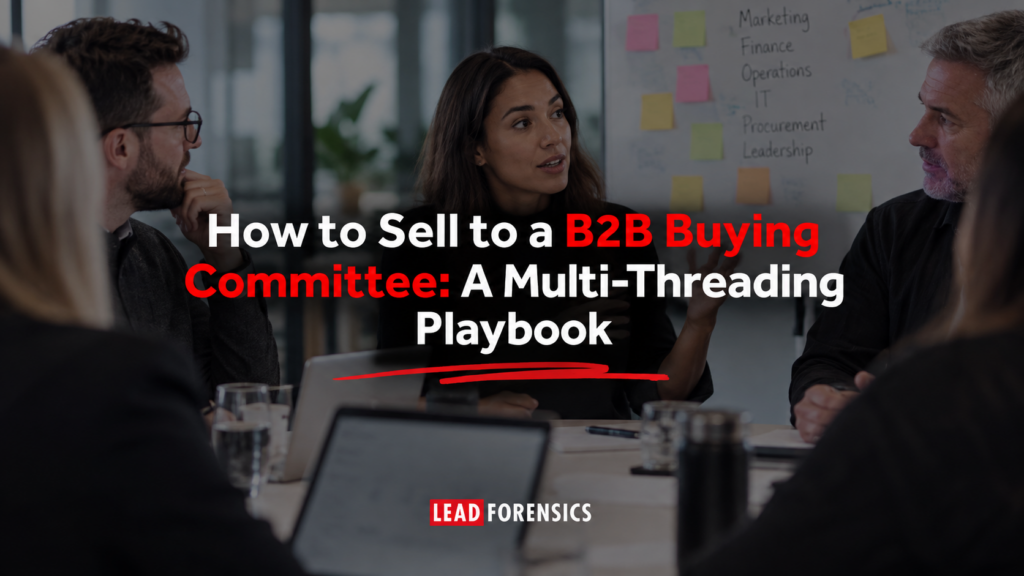
Most meaningful B2B purchases are group decisions. Estimates vary by deal size and methodology, but recent research commonly places buying groups at around ten people – and much larger for complex enterprise purchases (Forrester and Gartner benchmarks summarized by The Starr Conspiracy).
Gartner also reports that disagreement inside buying groups is widespread: 74% of B2B buyer teams show unhealthy conflict during the decision process (Gartner, 2025).
That changes the job of the seller. One enthusiastic contact is not the same as organizational consensus.
This playbook explains how to identify the people behind the decision, map their interests, engage them without undermining your champion, and reduce the risk of a late-stage “no decision.”
What is a B2B buying committee?
A buying committee, also called a buying group, is the set of people who meaningfully influence whether a purchase happens. It includes more than the person researching vendors or attending demos.
Depending on the purchase, the group may span IT, finance, operations, legal, procurement, security, and the team that will use the product. Not every stakeholder has equal authority, but any one of them may be able to delay or block the decision.
Buying groups have expanded for several reasons: tighter budget scrutiny, greater security and compliance requirements, cross-functional software deployments, and a desire to spread the risk of a bad decision. The practical result is simple: this is what B2B sales looks like now for anything beyond a simple, single-buyer purchase, and one relationship rarely carries the entire deal.
Why single-threaded deals stall
A deal is single-threaded when nearly all communication runs through one person. That contact may be helpful and genuinely enthusiastic, but you are relying on them to interpret your case, adapt it for other departments, answer objections, and build agreement when you are not in the room.
That is a lot to ask of anyone.
Signs your deal is single-threaded
The clearest sign is simple: you have only one active contact.
If every update, objection, introduction, and next step passes through the same person, your deal has a single point of failure.
Adding more names to the CRM does not necessarily solve the problem. You are still effectively single-threaded if those contacts are passive, all sit in the same function, or have no influence over the purchase. A genuinely multi-threaded deal has active relationships across several buying roles, not just several email addresses.
Other warning signs reinforce the diagnosis:
- Every update is secondhand: “I’ll run it by the team.”
- No one outside your contact’s department has joined a meeting.
- Your contact cannot name every approver or explain the approval process.
- Security, legal, finance, or procurement is described as a final formality.
- The next step depends on an internal meeting you cannot help prepare for.
- The deal would stall if your primary contact changed roles, took leave, or stopped replying.
The riskiest part of a single-threaded deal is not your sales call. It is the internal conversation after it. If your champion is outnumbered, outranked, or unable to answer a specialist objection, you may not find out until the deal has already lost momentum.
Step 1: Map the buying committee
Start with five functional roles. A person may occupy more than one, and some deals will include several people in the same role.
| Role | What they care about | Question you need answered |
|---|---|---|
| Champion | Solving the problem and building internal support | Will they actively advocate for change? |
| Economic buyer | Return, risk, budget, and strategic fit | Can they authorize the spend? |
| Technical evaluator | Security, integrations, implementation, and reliability | Can the product pass technical review? |
| End user | Workflow, adoption, and day-to-day value | Will people actually use it? |
| Blocker or gatekeeper | Compliance, commercial terms, policy, and downside risk | Can they stop or delay the purchase? |
For each person, record their influence, current position, primary concern, evidence required, and next action. Blank spaces matter: they show where your deal is exposed.
| Stakeholder | Role | Position | Main concern | Evidence needed | Next action |
|---|---|---|---|---|---|
| VP Operations | Champion | Supportive | Time to value | Implementation plan | Review rollout timeline |
| CFO | Economic buyer | Unknown | Payback period | ROI model | Request finance session |
| Security lead | Evaluator | Cautious | Data access | Security pack | Schedule technical review |
Step 2: Use discovery to uncover the decision process
Do not ask only, “Who is the decision-maker?” Complex purchases rarely have one.
Ask questions that reveal how the organization reaches agreement:
- “Who will be affected by this change, even if they are not involved day to day?”
- “Who will need to defend this investment when you are not in the room?”
- “Which teams usually review a purchase like this?”
- “Whose approval is hardest to secure?”
- “What happened the last time you bought a similar product?”
- “Who could raise a concern late in the process?”
- “If everyone likes the solution, what could still prevent the purchase?”
These questions feel less like an attempt to go around your contact and more like what they are: preparation for the internal process.
Step 3: Look for evidence beyond the call
Most buying committees do not introduce themselves. Buyers complete much of their research independently; Gartner reports that 61% prefer an overall buying experience without a sales representative (Gartner, 2025).
That makes indirect signals useful. Review new meeting attendees, forwarded materials, security questionnaires, procurement requests, mutual action-plan owners, and questions that clearly originated in another department. Public org charts and role changes may also help you form hypotheses, provided you confirm them with your champion.
Website visitor identification can add an account-level signal. Repeat visits from the same company to pricing, integration, security, or implementation pages may indicate that evaluation has spread beyond your original contact.
Treat this data as a prompt to ask better questions, not as proof that a specific person is ready to buy. Identification precision varies by tool, consent regime, network configuration, and region.
Step 4: Multi-thread without losing your champion
Multi-threading should make your champion’s job easier. It should not feel like an end-run around them.
Explain why another conversation will help, then ask for an introduction:
“It sounds as though Marketing and Compliance will both have input. Would it help to bring them into focused sessions now, so you do not have to relay every technical and commercial question yourself?”
If your champion hesitates, find out why. They may be protecting relationships, waiting for internal alignment, or unsure whether the deal is mature enough. Their reluctance is information, not permission to contact senior people behind their back.
When an introduction is appropriate, make it easy to forward:
“Would you be comfortable introducing us to Maya in Security? I can send a short note you can forward. We’ll keep the session focused on data access, authentication, and the review process.”
Step 5: Give every stakeholder a relevant version of the same case
Different stakeholders need different evidence, but they should hear one consistent story.
- Economic buyer: business impact, payback period, cost of delay, and commercial risk.
- Technical evaluator: architecture, security, integrations, implementation effort, and ownership.
- End user: workflow improvement, usability, training, and adoption.
- Legal or procurement: data handling, terms, vendor stability, and review timelines.
- Champion: a concise internal narrative that connects all of the above.
Gartner found that content relevant to the buying group can improve consensus, while messaging designed for one individual can deepen disagreement (Gartner, 2025).
The CFO’s ROI model and the IT team’s implementation plan should reinforce each other. If the financial case assumes a 30-day rollout while the technical plan requires six months, your materials create the objection for the buyer.
Step 6: Run workstreams in parallel
There is no universal stakeholder sequence, but a strong default is:
- Confirm that the champion has a real problem, influence, and motivation to act.
- Map the buying group and approval process.
- Begin technical validation early; it is often the longest workstream.
- Develop the financial case while technical evaluation is underway.
- Involve security, legal, and procurement before they become emergency steps.
- Bring the workstreams together in a mutual action plan with owners and dates.
The goal is not to put twelve people on every call. It is to give each stakeholder the right conversation at the right time, while keeping the buying committee aligned around the same outcome.
Common multi-threading mistakes
Going over the champion’s head
Unannounced outreach can damage the relationship you have. Agree on the introduction and its purpose whenever possible.
Sending everyone the same deck
Consistency matters; identical messaging does not. Adapt the evidence and level of detail to each role.
Confusing activity with coverage
Five contacts from the same team are not five buying perspectives. Measure coverage across roles and functions, not just the number of names in your CRM.
Treating gatekeepers as rubber stamps
Security, legal, and procurement can create legitimate work. Engage them early enough to resolve it without turning the end of the sales cycle into a crisis.
Interpreting all web activity as intent
Account-level visits can reveal useful patterns, but they do not tell you why someone visited. Combine behavioral signals with discovery and direct confirmation.
A five-minute buying committee check for every pipeline review
Before calling a complex opportunity healthy, ask:
- Can we name the champion, economic buyer, evaluator, users, and potential blocker?
- Have we spoken directly with more than one function?
- Do we know what each stakeholder needs to believe?
- Are the technical, financial, and approval workstreams moving in parallel?
- Is the next step tied to an owner and a date?
- Could the deal survive if our primary contact went offline tomorrow?
If the answer to the last question is no, the deal is still fragile.
FAQ
How many people are typically on a B2B buying committee?
There is no single universal average. Published estimates vary by study, purchase type, company size, and deal value, but complex B2B purchases commonly involve high-single-digit or low-double-digit groups.
What is the difference between a buying committee and a buying group?
The terms are generally used interchangeably. Both describe the people inside the buyer’s organization who meaningfully influence the purchase.
How do I know whether a deal is single-threaded?
If communication depends on one contact, you have not spoken to another function, or you cannot explain who evaluates, funds, approves, and may block the purchase, the deal is probably single-threaded.
Should I contact other stakeholders without my champion’s permission?
Usually, no. Start by explaining how direct specialist conversations reduce work and risk for the champion. Unannounced outreach is best reserved for situations where the relationship and account strategy clearly justify it.
Sell to the decision, not just the contact
Multi-threading is not about collecting more names or filling meetings with extra attendees. It is about helping a group reach a defensible decision.
Map the roles. Find the gaps. Give each stakeholder the evidence they need. Keep the story consistent. Move the workstreams forward before a late objection turns momentum into silence.
Your champion still matters enormously. The difference is that they should not have to carry the whole decision alone. If your motion already leans on named accounts and cross-functional buying groups, it’s worth pairing this with a proper account management approach rather than running it deal by deal.
Selling to today’s buying committees starts with getting the right initial “in”
Our Warm Calling guide explains how to use timely signals and relevant context to start a credible first conversation. Once you’ve established a potential champion, website visitor identification can reveal account-level research patterns that help you ask better questions, and multi-thread through well-timed introductions.