Skip to content

At a glance
- Performance marketing means paying for, and judging, marketing by measurable outcomes: clicks, leads, sales and pipeline.
- Budgets are still moving towards it. In the WFA and Ebiquity 2026 Media Budgets survey, 34% of global marketers expected to increase performance activity, against 24% for brand.
- Measurement is the weak point. Fewer than 3% of large advertisers are fully confident they can separate short-term performance effects from long-term brand impact.
- For B2B, the biggest gap is that most paid traffic never fills in a form. Performance marketing software that shows which companies your campaigns brought to your website closes that gap.
- A sensible stack covers five jobs: ad buying, web analytics, account-level visitor identification, CRM and automation, and reporting.
Paid media is getting more expensive to get wrong. UK digital advertising spend reached £40.5bn in 2025, up 10% year on year, according to the IAB UK and PwC Digital Adspend study. More money chasing the same buyers means every pound has to show its working.
That is the promise of performance marketing: you pay for results, you measure results, and you move budget towards whatever produces them. The difficulty, particularly in B2B, is that the result you care about (a qualified opportunity) often happens weeks after the click, and usually without a form fill in between.
This guide explains what performance marketing is, the software B2B teams use to run and measure it, how to choose the right tools, and the metrics worth reporting to your board.
What is performance marketing?
Performance marketing is a form of digital marketing in which advertisers pay for, or are held accountable to, a specific measurable action: a click, an impression, a lead, a sale. Pay-per-click search advertising and affiliate marketing are the classic examples.
Traditional media works the other way round. You pay upfront for exposure (a print advert, a radio slot, a billboard) and estimate the effect afterwards. Performance marketing flips that: the cost is tied to an outcome you can track, which gives you three things:
- Lower risk: you are not paying for activity that produces nothing measurable.
- Control: you can pause, cap or scale spend in hours, not months.
- Evidence: every channel, campaign and creative can be compared on the same basis.
Performance marketing vs brand marketing
Performance marketing is not a replacement for brand building, and the evidence says B2B marketers should be careful about treating it as one. Research by Professor John Dawes at the Ehrenberg-Bass Institute, carried out for the LinkedIn B2B Institute, found that only around 5% of business buyers are in the market for a given service in any quarter. The other 95% are not buying yet.
Performance marketing is very good at capturing that 5%. Brand activity is what makes sure you are remembered by the 95% when their turn comes. The practical takeaway: use performance marketing software to spend efficiently on in-market demand, and do not judge every pound of marketing by last-click results.
Common types of performance marketing
1. Search engine marketing (SEM)
Advertisers bid on keywords so their adverts appear in the sponsored results above organic listings, paying per click. Search remains the largest digital channel in the UK, at £17.9bn and 44% of all digital ad spend in 2025 (IAB UK). SEM is distinct from SEO, where rankings are earned rather than bought.
2. Paid social advertising
UK social ad spend grew 21% to £11.5bn in 2025, making it the fastest-growing major channel in the IAB UK study. For B2B, LinkedIn is usually the anchor because of its job title, seniority and company targeting, but paid social on other platforms can work well for reaching buyers outside working hours.
3. Display and programmatic advertising
Banner, native and video adverts bought across publisher sites, often through a demand-side platform. For B2B, the most useful development is account-based targeting: showing adverts only to people at the companies you want to reach. Lead Forensics data is available inside StackAdapt, for example, so marketers can target accounts by firmographics across native, display, audio and connected TV, with account-level reporting.
4. Native advertising
Sponsored content designed to match the look and feel of the platform it appears on, such as promoted articles on publisher sites or sponsored posts in a feed. It tends to suffer less from banner blindness, but must be clearly labelled as advertising.
5. Affiliate, partner and influencer marketing
Partners promote your product and are paid a commission on the leads or sales they generate. No result, no fee. In B2B, this often takes the form of referral partnerships, co-marketing with complementary vendors and creator-led content on LinkedIn.
What does performance marketing software do?
Performance marketing software is any tool that helps you plan, run, track, attribute or optimise campaigns against measurable outcomes. No single platform does all of it well, so most teams build a stack that covers five jobs:
- Buying and running media: ad platforms such as Google Ads, LinkedIn and programmatic DSPs.
- Measuring website behaviour: web analytics.
- Identifying who arrived: account-level visitor identification, so anonymous B2B traffic becomes named companies.
- Nurturing and tracking to revenue: CRM and marketing automation.
- Reporting and optimising: dashboards, BI and SEO/PPC research tools.
The third job is the one most B2B stacks miss. If only a small share of visitors fill in a form, your ad platforms can only ever report on that small share, and every campaign looks worse than it really is.
How we chose these tools
We selected tools that B2B marketing teams commonly use to run and measure performance campaigns, with at least one strong option for each of the five jobs above.
We favoured tools that integrate with mainstream CRMs, and we have deliberately left out most consumer-focused affiliate and app-install platforms because they are less relevant to B2B buying cycles. Lead Forensics is our own product; we have included it because it fills a specific gap, and we have been clear about what it does and does not do. Our own marketing team uses these tools day to day.
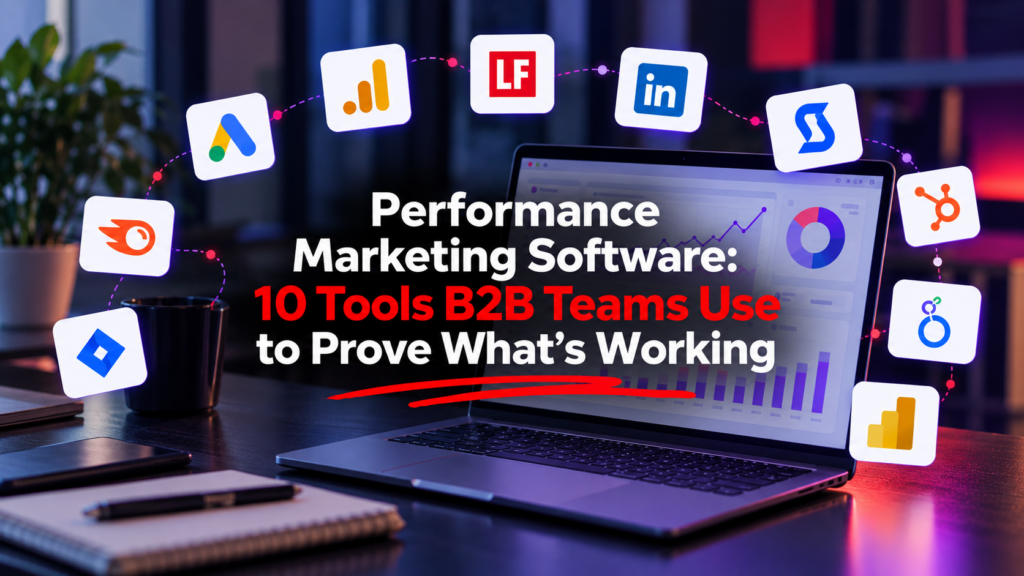
10 performance marketing software tools for B2B teams
| Tool | Category | Best for |
|---|---|---|
| Lead Forensics | B2B website visitor identification | Seeing which companies your campaigns bring to your site |
| Google Analytics 4 | Web analytics | Traffic, engagement and conversion tracking |
| Google Ads | Search and display advertising | Capturing active, in-market search demand |
| LinkedIn Campaign Manager | Paid social | Targeting by job title, seniority and company |
| StackAdapt | Programmatic advertising | Account-based display, native, audio and CTV |
| HubSpot | CRM and marketing automation | Nurture, lead scoring and closed-loop reporting |
| Looker Studio | Reporting dashboards | Free cross-channel reporting |
| Power BI | Business intelligence | Joining marketing and finance data |
| Semrush | SEO and PPC research | Keyword and competitor ad research |
| Jira | Project management | Running complex, multi-channel campaigns |
1. Lead Forensics: see which companies your campaigns actually reach
Category: B2B website visitor identification
Most B2B website visitors leave without filling in a form, so ad platforms and analytics tools can only tell you about sessions, not buyers. Lead Forensics identifies the businesses behind that anonymous traffic by matching visitors’ IP addresses against its own B2B IP database, built and maintained in-house, with a match rate of up to 80%.
For performance marketers, that turns “LinkedIn drove 1,200 sessions” into “LinkedIn brought 40 target-sector companies to the pricing page”. For each identified business you can see:
- Company name, industry, size and location
- Contact details for key decision makers
- The pages they viewed, how long they stayed and how often they return
- How they arrived, so visits can be tied back to the campaign or channel that drove them
Custom triggers alert sales when a target account returns, and leads flow into more than 60 tools, including Salesforce, HubSpot, Microsoft Dynamics 365, Pipedrive and Zoho. Lead Forensics is ISO 27001 certified and GDPR compliant, and identifies businesses rather than individual people. You can read more about the approach in our technical guide to B2B website visitor identification.
Worth knowing: visitor identification works at company level and complements, rather than replaces, your analytics and CRM. “Integrating Lead Forensics with Salesforce has been transformative. It’s become fundamental for us to have valuable discussions with our customers.” Chloe Barker, Head of Commercial, Coltraco Ultrasonics
2. Google Analytics 4
Category: Web analytics
Google Analytics 4 is the default starting point for most teams, and it is free. It tracks traffic sources, engagement and conversion events, and connects natively with Google Ads so you can import conversions and build audiences.
Worth knowing: GA4 reports on sessions and users, not companies. In B2B, where buying decisions involve several people at one organisation, you will usually need to pair it with account-level data to understand which businesses your campaigns reached.
3. Google Ads
Category: Search, display and video advertising
Google Ads remains the most direct way to reach buyers who are actively searching for a solution. Automated bidding strategies optimise towards the conversions you feed back, which makes the quality of your conversion data (and your offline conversion imports from the CRM) the single biggest lever on performance.
Worth knowing: if you only feed back form fills, Smart Bidding will optimise for form fills. Importing qualified opportunities from your CRM gives the algorithm a far better signal.
4. LinkedIn Campaign Manager
Category: Paid social
LinkedIn’s advertising platform lets you target by job title, function, seniority, company size, industry and uploaded account lists, which makes it a natural fit for B2B and account-based campaigns. Lead Gen Forms pre-fill with profile data to reduce friction.
Worth knowing: costs per click are typically higher than on other social platforms, so tight targeting and a clear view of which accounts actually engage after the click are essential.
5. StackAdapt
Category: Programmatic advertising
StackAdapt is a self-serve programmatic platform covering native, display, video, audio and connected TV. Its ABM tools let you target specific accounts, and Lead Forensics’ B2B data is available within it for firmographic targeting and account-level reporting.
Worth knowing: programmatic works best as a reach and air-cover channel for defined account lists. Judge it on account engagement and pipeline influence, not just click-through rate.
6. HubSpot
Category: CRM and marketing automation
HubSpot combines CRM, email, landing pages, lead scoring and attribution reporting in one platform. For performance marketers, its value is closed-loop reporting: connecting an ad click or first visit to the deal it eventually became.
Worth knowing: attribution in any CRM is only as good as the data going in. Consistent UTM parameters and clean lifecycle stages matter more than which attribution model you choose.
7. Data Studio (formerly Looker Studio)
Category: Reporting dashboards
Google’s free dashboarding tool connects natively to Google Ads, GA4 and Search Console, and to other sources through connectors. It is a practical way to put spend, leads and pipeline for every channel on one page.
Worth knowing: non-Google sources often need a paid third-party connector, so factor that into the “free” price.
8. Microsoft Power BI
Category: Business intelligence
Power BI is better suited than a marketing dashboard when you need to join marketing data with finance, sales and product data, for example to report customer acquisition cost or payback period by channel. Its natural-language Q&A feature lets non-analysts ask questions of the data.
Worth knowing: it rewards investment in a clean data model. Without one, it becomes an expensive way to draw the same charts.
9. Semrush
Category: SEO and PPC research
Semrush’s advertising research shows which keywords competitors bid on, sample ad copy and estimated paid traffic, which is useful for planning search campaigns and spotting gaps. It also covers SEO, content and local search.
Worth knowing: traffic and spend figures are modelled estimates, so use them for direction rather than as fact.
10. Jira
Category: Project management
Multi-channel campaigns involve creative, copy, landing pages, tracking and approvals. Jira (or a similar tool such as Asana or Monday.com) keeps tasks, owners and deadlines visible, which is what makes rapid test-and-learn cycles possible.
Worth knowing: it will not improve a campaign on its own, but it shortens the time between spotting a problem and fixing it.
How to choose performance marketing software
1. Start with the business outcome
Decide what the programme is accountable for (pipeline, revenue, qualified meetings, cost per opportunity) and work backwards to the tools that can measure it. A tool that optimises for clicks is not much use if the board judges you on pipeline.
2. Find the gap in your current data
Map what you can see today at each stage: impression, click, visit, engaged account, lead, opportunity, closed deal. The stage where the trail goes cold is where new software will have the most impact. For many B2B teams, it is the gap between “visit” and “lead”.
3. Check integrations before features
Performance data is only useful if it reaches your CRM and reporting. Favour native integrations with the systems you already use, and ask vendors to show the integration working rather than listing logos.
4. Ask hard questions about data and compliance
Ask where the data comes from, how it is validated, whether it identifies businesses or individuals, and how the vendor supports UK GDPR and PECR compliance. Look for recognised independent certifications such as ISO 27001.
5. Set a realistic budget
According to Gartner’s 2026 CMO Spend Survey, marketing budgets average 7.8% of company revenue, and 56% of CMOs say they lack the budget needed to deliver their 2026 strategy. Tools that consolidate several jobs, or that make existing media spend work harder, tend to be easier to justify than another point solution.
6. Test with your own traffic
Use free trials and demos, and insist on seeing results from your own website and campaigns rather than a pre-built sandbox. Lead Forensics offers a free trial so you can see which businesses are visiting your site.
7. Look at the support model
Check support hours, channels and whether you get a named account manager. Onboarding quality matters more than the feature list in the first 90 days.
Building a measurement chain: from impression to closed deal
Every B2B performance programme is a chain of links running from the first time a buyer sees an advert to the moment a deal closes. Most teams can measure the first few links well and the last one roughly. The links in between are where budget decisions go wrong.
| Link | What you need to know | Where the data comes from | Where it usually breaks |
|---|---|---|---|
| Impression | Did the right people see it? | Ad platforms | Targeting that is broader than it looks |
| Click | Did the message earn attention? | Ad platforms, GA4 | Optimising for cheap clicks, not the right ones |
| Visit | What did they do on the site? | GA4 | Sessions are counted, but companies aren’t |
| Engaged account | Which businesses came, and did they come back? | Visitor identification | Missing entirely in most stacks |
| Lead | Who raised their hand? | Forms, CRM | Only a small share of buyers ever fill in a form |
| Opportunity | Did sales accept it as real? | CRM | Inconsistent lifecycle stages and UTMs |
| Closed deal | What revenue followed? | CRM, finance data | Too far from the click to credit without a joined-up view |
Three rules for building the chain:
Fix the weakest link first. Before you add a channel, find the point where your data goes cold. For most B2B teams it is the gap between “visit” and “lead”, which is why a campaign can look like it’s failing when it is actually reaching the right companies.
Test where the chain is weakest, one variable at a time. If clicks are healthy but engaged accounts are low, the problem is the landing page or the offer, not the advert. Build creative from customer interviews, sales call insight and win/loss analysis, then test one variable at a time (headline, offer, format or call to action) and give each test enough volume to reach a meaningful result.
Send the later links back to the earlier ones. Import qualified opportunities into Google Ads and LinkedIn, and let account engagement data decide which audiences to scale. Platforms optimise towards whatever signal you give them, so give them the one closest to revenue.
Where performance marketing measurement breaks down
Last-click reporting undervalues the start of the journey
The WFA and Ebiquity’s 2026 research on paid media measurement covered advertisers with a combined $40bn in annual ad spend. It found that fewer than 3% are fully confident they can separate short-term performance effects from long-term brand impact, and only 15% say effectiveness evidence is the primary driver of budget setting. In B2B, where journeys run for weeks and involve several people, last-click models consistently undervalue the channels that start the conversation. Combine platform data with account-level engagement, CRM attribution and, where you have the scale, incrementality testing.
Every platform marks its own homework
Google, LinkedIn and your programmatic partner will each claim credit for the same deal, and their conversion totals will add up to more than your actual results. Treat platform reporting as directional, and use your CRM as the single source of truth for what actually converted.
Invalid traffic inflates the numbers
Bots and click farms produce clicks and impressions without ever producing a buyer. Use reputable networks, exclude poor-quality placements, watch for unusual click patterns, and check whether paid traffic comes from real businesses in your target market.
Privacy rules narrow what you can track
UK GDPR, PECR and browser restrictions on third-party cookies all limit how individuals can be tracked. Choose vendors that are open about their data sources and can explain their lawful basis for processing. Company-level identification, which does not track individual people, is one way to keep insight into campaign performance without relying on third-party cookies.
Performance marketing metrics and KPIs
| Metric | How it is calculated | Use it when the goal is |
|---|---|---|
| Cost per mille (CPM) | Spend ÷ impressions × 1,000 | Reach and awareness |
| Cost per click (CPC) | Spend ÷ clicks | Website traffic |
| Click-through rate (CTR) | Clicks ÷ impressions | Testing creative and relevance |
| Cost per lead (CPL) | Spend ÷ leads | Lead generation |
| Cost per acquisition (CPA) | Spend ÷ customers won | New customers |
| Return on ad spend (ROAS) | Revenue ÷ ad spend | Revenue efficiency |
| Target accounts engaged | Target companies that visited after exposure | Account-based campaigns |
| Pipeline influenced | Opportunity value with a campaign touchpoint | Proving B2B impact |
For B2B teams, the last two rows are the ones that tend to win budget arguments, because they connect media spend to the accounts and opportunities sales actually care about.
Judge campaigns by the companies they reach
Cheap clicks and high lead counts are easy to buy. What counts is whether the right businesses are engaging and whether that engagement turns into pipeline. The best performance marketing software shows you the companies behind the click, so you can move budget to wherever your buyers actually are.
See which businesses your campaigns are bringing to your website with a free trial of Lead Forensics.
Performance marketing software FAQs
What is performance marketing software?
Performance marketing software is any tool used to plan, run, track, attribute or optimise campaigns against measurable outcomes such as clicks, leads, sales or pipeline. It typically includes ad platforms, web analytics, visitor identification, CRM and marketing automation, and reporting tools.
What is the difference between performance marketing and digital marketing?
Digital marketing covers all online marketing, including organic social, SEO and content. Performance marketing is the subset where spend is tied to, and judged by, a specific measurable action.
Is performance marketing effective for B2B?
Yes, provided it is measured properly. Long sales cycles and buying groups mean last-click metrics understate its impact. B2B teams get the most from performance marketing when they track which companies engage after the click and whether those companies become opportunities, and when they balance it with brand activity that reaches buyers who are not yet in market.
How do you measure performance marketing when buyers don’t fill in forms?
Measure at account level as well as lead level. Visitor identification shows which companies arrived from each campaign and what they looked at, and your CRM shows which of those companies later became opportunities. Two metrics are worth adding to standard reporting: “target accounts engaged” and “pipeline influenced”. Together they give a far more accurate picture than form fills alone.
Is performance marketing the same as demand generation?
No, but the two overlap. Demand generation covers everything that creates and captures interest across a buying group, including brand, content and organic activity. Performance marketing is the paid part of that work, where spend is tied to a measurable action. It is best at capturing buyers who are already in market, while wider demand generation keeps you in mind with the buyers who aren’t there yet.
How much does performance marketing software cost?
It varies widely. Tools such as Google Analytics 4 and Looker Studio are free, while CRM, visitor identification and BI platforms are usually priced by seats, features, data volume or website traffic. Most vendors offer a trial or demo, so compare cost against the pipeline the tool helps you attribute.