Skip to content

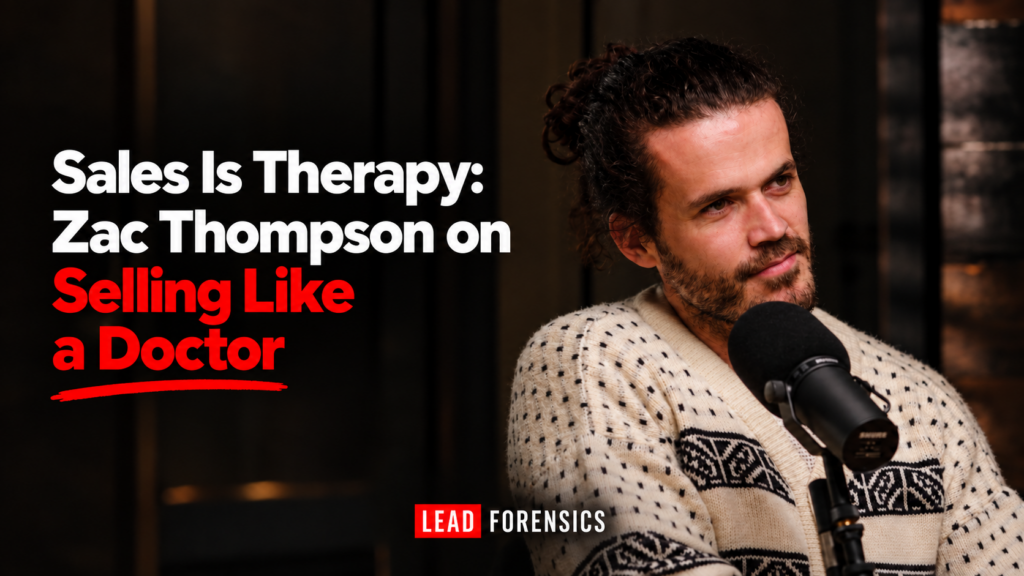
Zac Thompson thinks that’s how sales should work, and that most salespeople do the opposite. Zac is the founding director of We Have a Meeting, an outbound agency that helps sales teams fix low-quality meetings, bad-fit leads and thin pipelines. He co-hosts the We Have a Meeting podcast and co-wrote Sales Is Therapy with his business partner, Jack Frimston.
When Zac joined me on What I Wish I’d Known About Sales, our podcast for salespeople, he explained what selling like a doctor (or a therapist) looks like in practice, from the first cold call to what you allow into your pipeline.
Diagnose before you prescribe
Asked what he wished he’d understood earlier, Zac’s answer was simple: sales is about the buyer, not the seller. A lot of salespeople are taught the opposite. Just get in front of people, show them the product, and they’ll love it.
“You don’t go to the doctor, and the doctor sits you down and says, ‘Before we start, let me tell you how great I am as a doctor.’ That never happens. The doctor first sits you down and says, ‘Why are you here? What’s the problem you’re trying to solve? How long has it been going on for?'”
As Zac puts it, “when you bring what works in real life into sales, it works ten times better.”
He sees the opposite belief all the time in founders who come to him saying “we’re great when we get in front of people.” They think they need more meetings. Often the meetings happen and nobody closes, because, in Zac’s words, “their love is blind.” They’re so attached to what they’ve built that they can’t see the buyer isn’t that interested. Starting with the buyer’s problem fixes this. Our guide on what to say on a first call follows the same principle.
Why therapy, not relationships?
Early in his career, Zac was taught that sales is all about relationships, which in the UK often meant taking clients out drinking. He thinks it’s wrong, and not only for ethical reasons:
“Gradually, every year, because of that relationship, they pay less and less and less. So any industry that’s built on this relationship-building style has a big, massive, long curve that’s this big race to the bottom, till the profit margins are totally sucked out of it.”
When he set up his own business, he wanted a method that didn’t leave new salespeople feeling they “needed to go and have a shower” after a day’s work, and one that actually performed. He kept coming back to one setting: “the area where people are most honest with their problems and have the most opportunity to change is in a therapy setting.”
That matters most at the top. “Being a CEO is a very lonely place,” Zac says. If you want to solve a CEO’s problems, “you’re probably better being the therapist rather than the salesperson.”
What a therapy-style cold call sounds like
Zac gave a live example using Lead Forensics. To be clear, that was his choice, not ours, and we’ve kept his critique of the classic pitch as he said it. Here’s the classic SDR approach:
“Zac, I know that you’re a business owner. We’re an award-winning tool that helps people see the visitors on their website. I just want to get fifteen minutes in your diary to show you how that would work.”
And here’s the therapy approach:
“Zac, I’m normally brought in by people who are really ambitious. They’ve built great websites, but they recognise that people who are visiting those websites are not converting in the way that they would like them to. And as a result, they’ve just got this horrible feeling: am I missing opportunities? Is the website working as well as it should?”
The first version is all about the seller. The second is about the buyer: their ambition, their investment and the worry they may not have said out loud. In Zac’s experience, that’s when people open up. They admit they’ve spent a lot on the website and conversion isn’t where it should be. “Suddenly we are in this therapy session,” he says, rather than a call about grabbing 15 minutes for a demo.
Zac prefers the phone for this. “There’s no faster way to actually qualify someone,” he says. “The purpose of a cold email is to get someone on a call. Why not skip that step and just get them on a call first?” Our guide to cold calling in B2B covers the basics. If you know a company has already visited your website, you can make a warm call instead of a cold one, and the therapy opener fits even better.
He also suggests leaning into sounding human, “even human in an awkward, clunky kind of way, because AI sounds a bit too clean and clinical.” As more outreach is written by AI, that slightly imperfect human tone may be what stands out.
Empathy is something you do, not something you claim
Ask salespeople whether they’re good listeners and almost all of them will say yes. Zac isn’t convinced:
“You don’t hear people openly admit, ‘I’m not very empathetic, and I’m not a very good listener.’ The reality is most of us aren’t that empathetic, and most of us aren’t that great listeners.”
Listen back to your own calls, he suggests, and you’ll hear what you missed: “the little pause where they got a bit nervous about opening up too much, the bit where they stumbled over their words, the bit where suddenly they said, ‘yeah, I am under a lot of pressure.'” Too many reps hear that and go straight to asking for 15 minutes. Very few say, “it sounds like you’re in a really tough spot. What’s going on?”
The best example Zac knows isn’t a salesperson. It’s his stepdad, a well-loved taxi driver in Blackpool:
“People can get in his cab and talk about anything, and he’s going, ‘Bloody hell. How long were you doing that for? God, it sounds like a nightmare.’ They know nothing about him. All they know is that he’s a great listener, a great empathiser.”
And people ask for him again by name.
Ask “why now?”
Zac once asked a therapist on his podcast for the best question to get someone to open up. Her answer was “why now?”, and he’s used it on every call since.
“As soon as someone gets onto ‘I’m in a problem’: why do you need to do something about that now? That is the golden nugget. Everything falls into place in that question.”
Questions about what someone is doing and how it’s going get polite, surface-level answers. “Why” questions make people stop and think, and that’s where you find their real motivation. It also tells you whether there’s a real trigger behind the conversation, an idea James Newell explores in our post on sales messaging rules.
Keep hope out of your pipeline
Is outbound broken? Zac doesn’t think so. “It’s not broken for good,” he says. “It probably just needs fixing.” The problem, he says, is an idea he took from advertising executive Rory Sutherland: short-term fixes that create long-term problems. SDRs are told to get anything into the diary. AEs log every conversation as an opportunity. Leaders show the inflated pipeline to investors. The result is meetings for their own sake and demos for people who don’t have a problem.
“You can’t have hope in your pipeline. It should just be on yeses and nos.”
He suggests two rules sales leaders can put in place:
- Target SDRs on attended meetings, not booked ones. If reps are only paid when prospects show up, they have to qualify leads properly first.
- No diarised next step, no opportunity. If a follow-up hasn’t been booked and accepted by both sides, it doesn’t go in the pipeline.
On the second rule, Zac doesn’t mince his words: “It’s just me waiting to hear back from someone who’s probably just said yes to get me off the phone.” Pipelines full of these deals are why so many forecasts are wrong.
Sell the 4.7-star version, not the five-star one
Zac’s choice for the most overrated sales phrase is “we can absolutely do that.” Overpromising sets you up to disappoint:
“Even if your product is great, it will be disappointing because it’s not perfect. Sell the 4.7 Amazon review, not the five-star one. People will trust it more.”
There’s research behind this. Northwestern University’s Spiegel Research Center, in research first published in 2017, found that purchase likelihood typically peaks at ratings between 4.0 and 4.7, then falls as ratings approach 5.0. Perfection looks suspicious.
The same honesty applies to price. Zac would rather have transparent pricing and no discounts than an end-of-month scramble to match competitors. If a prospect says a rival is offering 25% off, the answer isn’t to offer 30%. It’s to ask why they’re still talking to you, because the reason they’re still in the conversation is the value you should be selling. Our guide to handling common sales objections has more on price pushback.
Find a why that doesn’t run out
Zac’s advice on motivation goes deeper than most. Early on, his goal was a beach holiday. He’d hit his numbers, go away, then come back and have a poor run until he found a new goal. What changed things was finding a reason that didn’t run out. He paraphrases Nietzsche: “with the right why, you can bear any how.”
He also thinks the best salespeople are a little detached. “The best salespeople are actually quite indifferent to the whole process,” he says, “but the ones that have the most sporadic performances tend to get really high off the wins and really low off the losses.” When a deal falls through, keep it in perspective. Zac’s tip is to open a map of where you are and keep zooming out. From space, the lost deal doesn’t look like much.
Be the therapist
None of Zac’s advice needs a new tool or a new script. Ask why the buyer is here before telling them about yourself. Notice the pause. Ask “why now?” Only count what’s real. Undersell slightly and deliver well.
A therapy-style opener works best when you already have some idea of what’s on a buyer’s mind. If a company has spent time on your pricing and product pages, you have a starting point. Learn how to spot buyer intent, and use real-time alerts when target accounts visit your site to call while the problem is still on their mind.
Book a demo of Lead Forensics to see which companies are visiting your website, and start your next call with their problem, not your pitch.
About Zac Thompson
Zac Thompson is the founding director of We Have a Meeting, an outbound sales agency, and co-hosts the We Have a Meeting podcast.
Zac and his business partner, Jack Frimston, met at school in Lytham and both got their first sales jobs at 16, in a local call centre, according to a Blackpool Gazette feature. Sales Is Therapy came out in May 2025 with a foreword by entrepreneur and author Daniel Priestley, and guests on their podcast have included former FBI negotiator Chris Voss and Rory Sutherland. You can follow Zac on LinkedIn, where he posts regularly about outbound sales.
About this article
This article is based on an interview with Zac Thompson recorded for Lead Forensics’ podcast, What I Wish I’d Known About Sales. Quotes are taken from the recording and lightly edited for readability, with filler words and false starts removed. Nothing has been paraphrased inside quotation marks. Research claims link to the original source.